
Accounts and fees
The accountant sees at any moment who has paid and who is behind, in the school's main currency and in every other currency it accepts, without gathering ledgers at the end of the month.
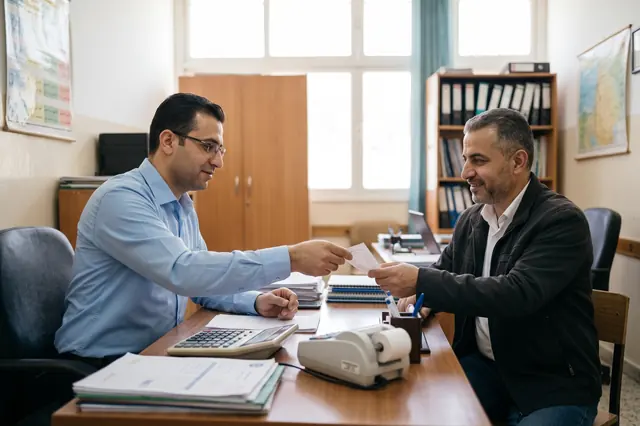
Fewer hours on the books
The finance office's routine, before Shams and with it.
Taking a payment
BeforeA handwritten receipt, then the same amount copied into the ledger and onto the student's fee card.
With ShamsRecord a full or partial payment, in cash, by bank transfer or by cheque. The receipt prints with the school's logo and the student's statement is up to date.
Who is behind this month
BeforeGoing through every fee card by hand, then phoning each family.
With ShamsThe list of outstanding fees by class and section, and a reminder by text message or e-mail from the same screen.
Bank transfers
BeforeA parent brings a printed transfer slip to the office during working hours.
With ShamsThe parent uploads a photo of the slip from their account. You approve it, or return it with the reason.
Monthly salaries
BeforeSalaries worked out in a spreadsheet, next to the staff attendance book.
With ShamsEach staff member's month shows salary beside attendance and leave. Add allowances and deductions, and Shams works out the net and prints the payslip.
The new year
BeforeUnpaid balances copied by hand into next year's books.
With ShamsUnpaid balances carry forward into the new year with each student.
Each student's statement
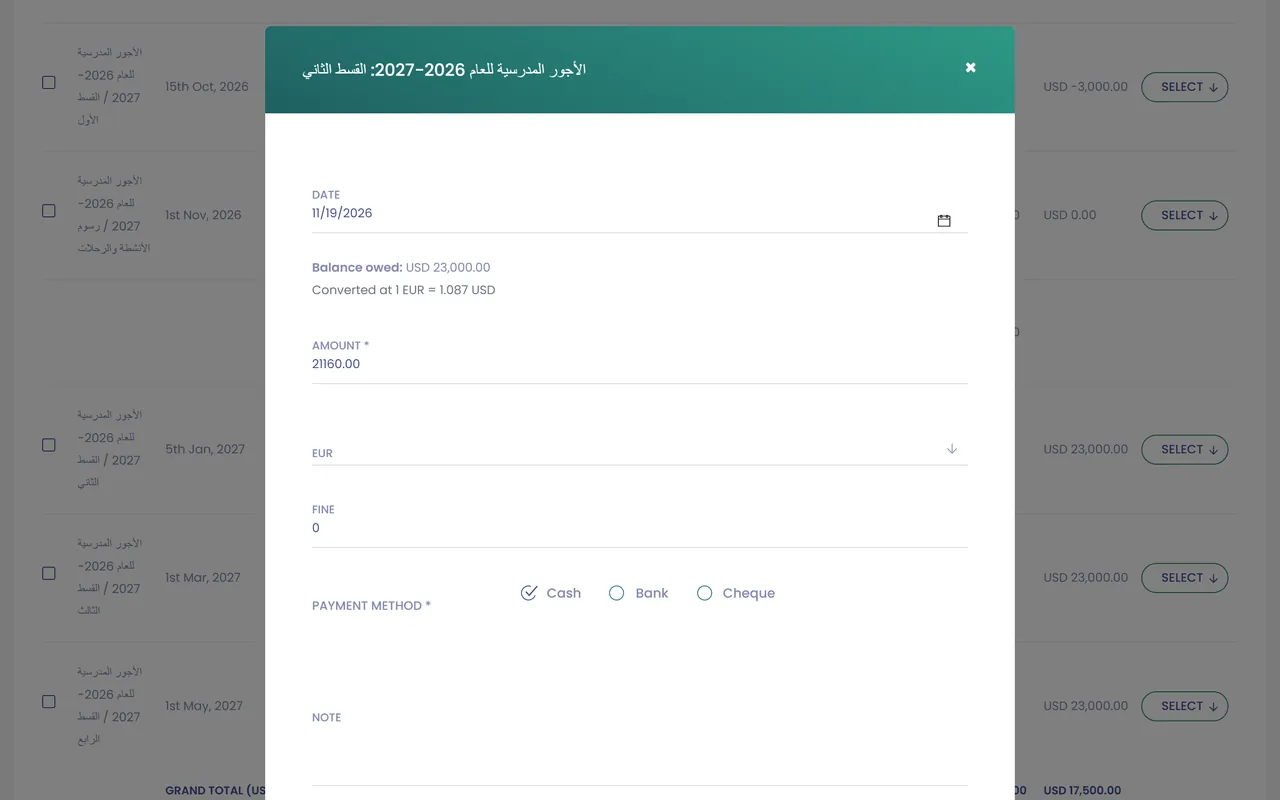
Open a student and every fee assigned to them is there: the amount, any discount or fine, what has been paid and what is outstanding. Collect a payment from the same screen and print the receipt in three copies, one for the family, one for the office and one for the file.
Parents see the same figures in their own account, so a question about a balance starts from the same page on both sides of the desk.
What the accounts office works with
The fee structure
- Fee groups, such as a term or registration, holding fee types such as tuition, bus, books and activities.
- An amount, a due date and a currency for each fee, and an optional late fine.
- Fees assigned to one student or to a whole class in one step.
- Discounts, such as for brothers and sisters or a scholarship, assigned to the students who receive them.
Collection and receipts
- Full or partial payments, in cash, by bank transfer or by cheque.
- A three-copy receipt with the school's logo, invoices, and bulk invoice printing.
- A search across every payment the school has taken.
Outstanding fees
- Who owes what, by class, section or student.
- Reminders to parents by text message or e-mail.
- Overdue totals by class on the management's dashboard.
Bank transfers
- Bank transfer slips uploaded by parents, approved or returned with a reason.
The school ledger
- Income and expenses under your own headings, with a copy of each invoice.
- Bank accounts, each in its own currency, and transfers between them.
- A profit and loss statement for any period.
Payroll
- The month's salary beside the staff member's attendance and leave.
- Allowances and deductions, with the net worked out for you.
- Payslips for one person or the whole staff, and salaries paid recorded in the ledger.
Sponsors
- A relative, charity or donor linked to the students whose fees they pay.
- The sponsor pays at the office like a parent, and the receipt is issued in the student's name.
Who sees the money
- Fees and balances only for staff with the permission to view them.
- Salaries only for payroll staff, and each employee sees their own payslip.
- Teachers and students see no amounts, not even in dashboard charts.
Every currency the school takes
Many schools set some fees in one currency while families pay in another. In Shams you choose the school's main currency and add the others you accept, each with its exchange rate.
Shams is a school ledger rather than a general accounting package: it covers the fees, the school's income and expenses, its bank accounts and its salaries, which is what a school's finance office works with every day.
- A fee is set in the currency you choose, and a payment is recorded in the currency the parent pays.
- A bank account for each currency, with transfers between them.
- The profit and loss statement shown in any currency you defined, at the rate you stored.
What to ask us in your session
Bring your fee schedule along, and ask us to work through it with you:
- Set up our fee groups, types and due dates, with a discount for brothers and sisters.
- Take a partial payment and print the receipt.
- Show how a second currency is set up and collected at our exchange rate.
- List the outstanding fees for one class and send the reminders.
- Approve a bank transfer slip from a parent's account, and return another one.
- Run a month's payroll for one staff member, from attendance to payslip.
See Shams with your own school in mind
Book a session with our team. We walk you through Shams on screen, answer your questions and show the parts that matter to your school.