
Organizing school homework: how a school stops it piling up on one day

On the last day of the school week, an eighth grader opens his backpack to find four assignments due first thing next week: math exercises, a science report, an essay and two pages of vocabulary. None of his four teachers knew what the others had assigned. His parents only find out from him, late on the weekend, and the next morning the teachers discover that half the class has left the work unfinished. The problem is not homework itself. It is that nobody organizes school homework across the whole school, so every teacher decides in isolation what to assign and when it is due.
How does a school organize homework?
The short answer: a school organizes homework with a written policy that sets a daily time limit for each grade, spreads each subject's homework across the week in a plan for every section, and requires every assignment to carry a clear due date and instructions both students and parents can understand. Each week, the homeroom teacher reviews the turn-in record and contacts the parents whenever a student repeatedly falls behind.
How much time should school homework take in each grade?
Many educators follow what is known as the ten-minute rule: a student spends about ten minutes a day on all their homework for each grade they have reached, so a first grader needs ten minutes and a sixth grader about an hour. Crucially, this limit covers all subjects combined rather than a single subject, which means a school can only keep to it when the teachers of each section coordinate.
| Grades | Suggested daily time for all homework |
|---|---|
| 1 and 2 | 10 to 20 minutes |
| 3 and 4 | 30 to 40 minutes |
| 5 to 7 | 50 to 70 minutes |
| 8 and 9 | 80 to 90 minutes |
| High school | About two hours, with room for exam-year subjects |
You can adjust these figures to suit your students, as long as you write them into your policy and share them with teachers and parents alike. Teachers then know the limit they are working to, and parents know what to expect from their child at home.
How should a school spread homework across the week?
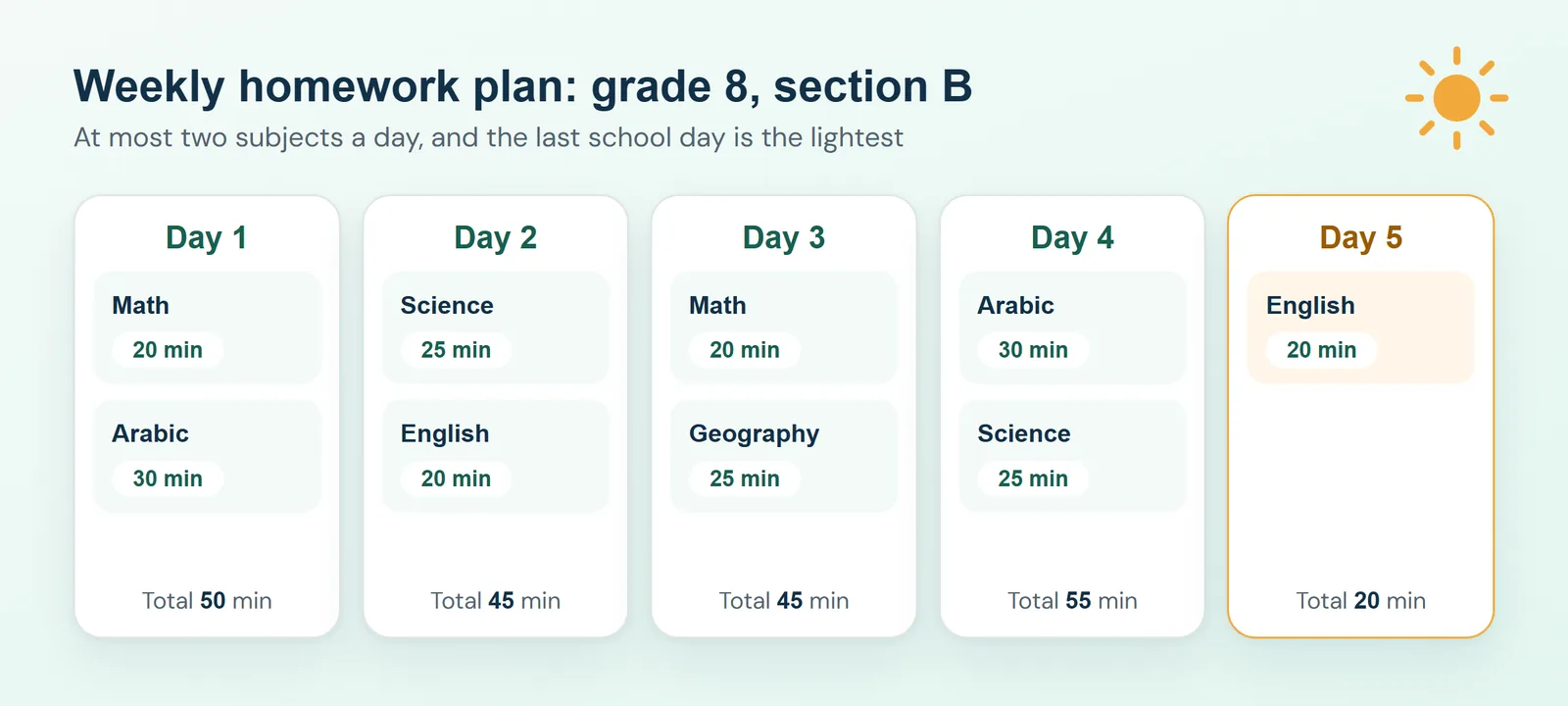
The most reliable way to stop homework piling up is for the homeroom teacher, working alongside the supervisor, to build a weekly homework plan for each section, based on the weekly timetable and guided by these rules:
- Fixed days for each subject: homework is assigned in the subject's class period and collected at its next one, so students always know in advance what is due each day.
- A daily ceiling: no more than two major assignments are due on the same day; anything beyond that shifts to another day by agreement among the teachers.
- The weekend: a section gets no more homework on the last day of the school week than on any other day, so the weekend does not turn into more working days.
- Test week: homework is scaled back in the week of the tests, so students have the time they need at home to review.
What should a homework assignment say so students and parents understand it?
A clear assignment lets a parent follow along without having to ask their child what the teacher meant. To achieve that, every assignment includes five things: the subject and section, exactly what is required with page and exercise numbers, the due date with its day, the expected time it takes, and how to turn it in. The templates below are ready to copy.
Template for a daily assignment
Math, grade 8 section B: solve exercises 3, 4 and 5 on page 62. Due: Monday, November 30, 2026. Expected time: 20 minutes. Turn in your answers in your notebook at the first math class.
Template for a week-long assignment
Science, grade 8 section B: a one-page report on the water cycle, with a diagram. Due: Thursday, December 3, 2026. Expected time: one hour, spread over the week. Upload a photo of the report from your student account or turn it in on paper.
Template message to a parent when homework keeps being missed
Mrs. Rana Al-Ahmad, your son Omar has not turned in three assignments this week, in math and science. Please follow this up with him; for any questions, contact his homeroom teacher. The school office.
How does a school keep track of who turned homework in?
Homework loses its value the moment students realize nobody is checking it, which is why consistent follow-up rests on three clear steps:
- Grading before the next assignment: the teacher grades and returns the homework, or records its grade, before giving the section a new assignment in the same subject, showing students that their effort counts.
- A weekly check by the homeroom teacher: at the end of every week, the homeroom teacher reviews the turn-in record for their section across all subjects. Missing a single assignment calls for a quick reminder, while missing three in a week, or repeatedly missing the same subject, calls for contacting the parents.
- Looking for patterns across the section: when half a section misses the same assignment, the reason is usually that the task was too long or poorly explained, so the supervisor reviews it with the subject teacher rather than penalizing the students.
A checklist for your school's homework policy
- Daily time for each grade: written into the policy and shared with teachers and parents.
- A weekly plan for each section: drawn up by the homeroom teacher and the supervisor from the weekly timetable.
- A daily ceiling: at most two major assignments due on the same day.
- Fixed elements in every assignment: what is required, the due date, the expected time and how to turn it in.
- Grading before the next assignment: in every subject and every section.
- A review at the end of every week: the turn-in record for each section, and a call to parents when missed work repeats.
- Lighter homework in test week: announced to teachers before the week begins.

How does Shams make organizing school homework easier?
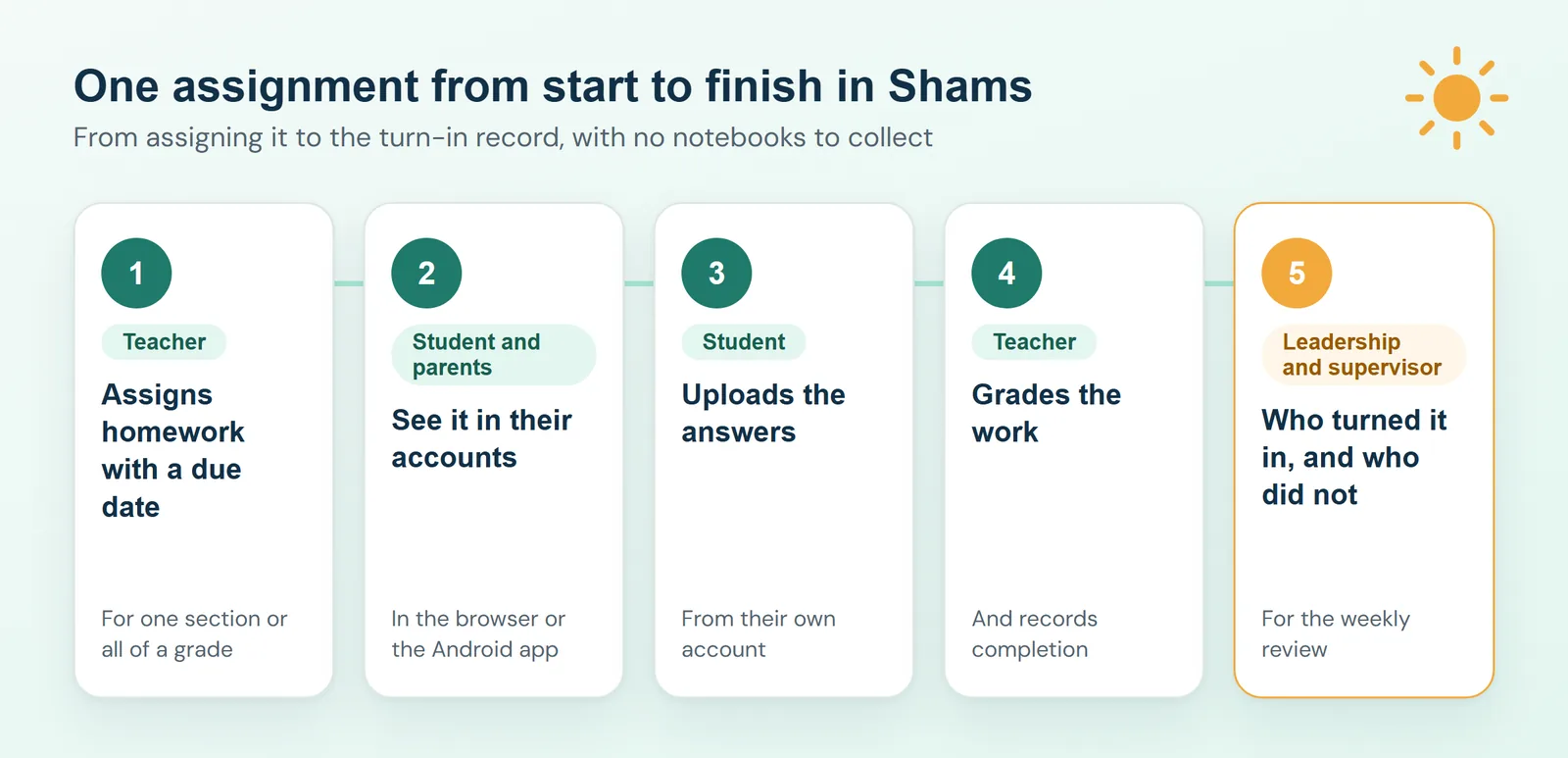
In Shams, a teacher assigns homework to one section or to every section of a grade from the quick actions at the top of their page, choosing its date, due date and points, and attaching a file when needed. The assignment appears in the student's account, in the browser or the Android app, where the student uploads their answers, and it appears with its due date in the parent's account, so parents no longer have to rely on their child alone to hear about it. The teacher then opens the grading screen, downloads each student's work and records its grade and completion status. The result is a clear record of who turned in each assignment and who did not, which school leaders and the supervisor can turn to in the weekly review without collecting a single notebook.
See the homework cycle with your teachers
Book a session and bring some of your teachers along. We will walk through one assignment from start to finish: giving it to a section with a due date, what the student and parents see in their accounts, and the record of who turned it in.